The Joint Vision Statement on ASEAN-Japan Friendship and Cooperation, adopted in 2023 to commemorate 50 years of ASEAN-Japan friendship, pointed to health care as a priority in “co-creating the future economy and society.” In response, JCIE has been considering the establishment of a multi-stakeholder dialogue platform that brings together governments, researchers, civil society, and the private sector to promote the co-creation of solutions to common health challenges between Japan and ASEAN.
Working with the Nagasaki University Graduate School of Planetary Health DrPH Program (Nagasaki DrPH Program), which trains professionals in public health, we commissioned a survey on which themes should be prioritized for cooperation between Japan and ASEAN on health issues.
The objective was to identify issues common to Japan and ASEAN that may lead to solutions through public-private partnerships, and to derive recommendations for the direction of a Japan-ASEAN Health Dialogue. The project entailed a literature review and interviews with various stakeholders.
On October 16, 2025, just before the final compilation of the report, we also held an online seminar to announce the results of the survey in collaboration with the Nagasaki DrPH Program. The seminar was attended by experts who are active on the front lines in Japan and ASEAN countries, and lively discussions were held.
The results have been published in the following report:
ASEAN-Japan Health Dialogue: Strategic Recommendations for Public-Private Collaboration
Some of the key priorities identified through the survey and research include the following:
Priority 1: Non-communicable diseases (NCDs)
In recent years, there has been a call to consider the “commercial determinants of health (CDH)” as well as social determinants of health in order to prevent NCDs. However, unlike infectious diseases, NCDs themselves are “non-infectious” and are influenced by individual lifestyles, so there has not always been a high level of political attention to NCD countermeasures. It is important to shift the focus from “treatment” to “prevention.” In addition, the UHC Knowledge Hub, jointly established in Japan by the World Bank and the World Health Organization (WHO), can be utilized to build sustainable health finance through knowledge sharing, the creation of innovative financing mechanisms (including the introduction of “health taxes” on products that have adverse health effects), and the promotion of partnerships with the private sector.
Priority 2: Digital health
Regulations on medicines and devices, as well as regulations and governance for healthcare data, vary from country to country, and in some cases, are unclear, which can be a barrier for private companies to enter the market. Another challenge is that fragmented systems hinder interoperability. On the other hand, when collecting and using data, there are situations where people do not necessarily trust privacy and security measures, and it is necessary to consider the ethics and regulations regarding data handling. Efforts are needed to share advanced and successful examples of strengthening digital health, and to jointly design governance mechanisms that enable data interoperability across the region.
Promoting Wellness Using Digital Tools
The research also suggests further use of digital technologies for NCD prevention. In recent years, the proliferation of smartphone apps and software as a medical device (SaMD) that utilizes artificial intelligence (AI) technology has opened up new possibilities, but on the other hand, there are disparities in digital infrastructure between countries and regions, and there are also disparities in digital literacy, including among health care workers. Networks are needed that bring together health care professionals with medical facilities and local health authorities through digital tools. Also, effective use should be made of telemedicine to mitigate the impact of uneven distribution and shortages of health care workers, and to prevent NCDs and promote “wellness.”
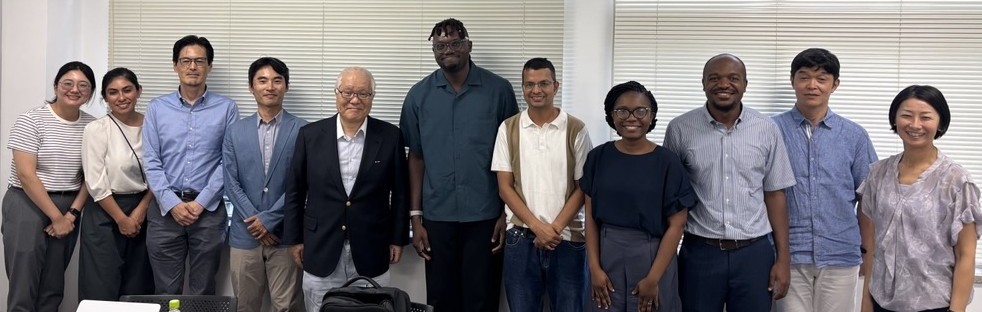
Team Members from the Nagasaki University DrPH Program
Oluwaseun Adebayo Adewunmi (from Nigeria)
Due Emmanuel Awai (from Nigeria)
Prakash Chandra Bhatta (from Nepal)
Chanida Ekakkararungroj (from Thailand)
Ruth Purisima Gonzalez Sanchez (from Mexico)
Mavis Sakyi (from Ghana)