
Roundtable with Japanese Diet Members on Sustaining Health Programs for Infectious Diseases in Africa
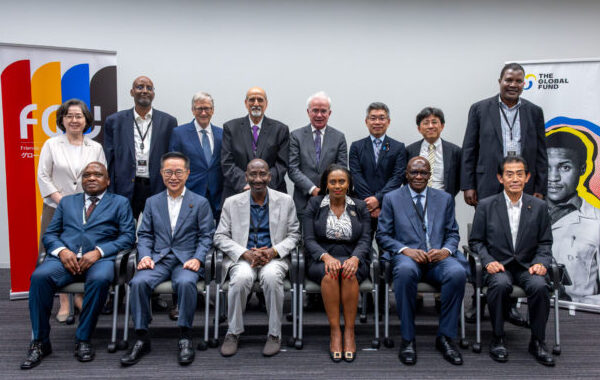
Ahead of the 9th Tokyo International Conference on African Development (TICAD9), FGFJ convened a roundtable with Japanese Diet members on “Fighting the Good Fight: Sustaining Health Programs for Infectious Diseases in Africa.” The meeting welcomed Bill Gates (Gates Foundation), Dr. Abdoulaye Djimdé (5th Hideyo Noguchi Africa Prize Laureate), Peter Sands (Global Fund), and others.
FGFJ TICAD9 Thematic Event | Sustainable Health Financing in Africa: From Commitments to Action
The Global Fund to Fight AIDS, Tuberculosis and Malaria and the Japan Center for International Exchange (JCIE)/Friends of the Global Fund, Japan (FGFJ) co-organized a thematic event titled “Sustainable Health Financing in Africa: from Commitments to Action” on the occasion of the Ninth Tokyo International Conference on African Development (TICAD 9), held in Yokohama in August.
WEBINAR | Post-TICAD9 and Pre-G20 Summit Briefing on Japan-Africa Partnership

The Japan Center for International Exchange (JCIE USA) hosted a webinar on October 22 with four distinguished speakers to provide Japanese, US, and African perspectives on Japan-Africa partnership. The discussion addressed how a “win-win” partnership can be strengthened through private sector investments and in alignment with the United States. It was also an opportunity to reflect on the outcomes of Japan’s leadership at the 9th Tokyo International Conference on African Development (TICAD9) in August as well as expectations for the G20 summit in November as South Africa prepares to hand over its presidency to the United States.
JCIE Publication | Africa-Japan Common Vision on Health
In preparation for the 9th Tokyo International Conference on African Development (TICAD9), JCIE launched a working group comprised of Japanese and African experts on health and development to define the future direction of Africa-Japan partnership in the health sector toward and beyond 2030. The group has produced a “Common Vision”—a set of recommendations and key principles for multi-sectoral collaboration to co-create health security and sustainable growth in Africa and Japan.
TICAD9 Event | Africa-Japan Common Vision on Health
On August 21, 2025, JCIE convened globally renowned leaders in health, science, policy, and business from Africa and Japan to introduce and deepen discussions on a Common Vision calling for cooperation on co-creating health security and sustainable growth. The event delivered a compelling message focusing on health as a driver of economic growth and mutual benefit.
Africa-Japan Common Vision on Health—Recommendations for TICAD9
Toward the 9th Tokyo International Conference on African Development (TICAD9) to be held in Yokohama in August 2025, JCIE launched a project to define the future direction of Africa-Japan partnership in the health sector beyond 2030, and propose a common vision which can be shared among public and private stakeholders in Africa and Japan.
JCIE Global Health Special Series | Are Disease-Specific Approaches Compatible with the Goal of Achieving Universal Health Coverage?

This blog post, the third in the JCIE Global Health Special Series, looks specifically at projects in Ethiopia and Burma to determine if disease-specific programs are compatible with the mission of Universal Health Coverage.
JCIE Publications | Containing Conflict: Cases in Preventive Diplomacy

The authors analyze the international community’s responses to conflicts in locations such as the African Great Lakes region, helping them to draw lessons for managing regional conflict through preventive diplomacy.
JCIE Publications | Building Resilience: Human Security Approaches to AIDS in Africa and Asia
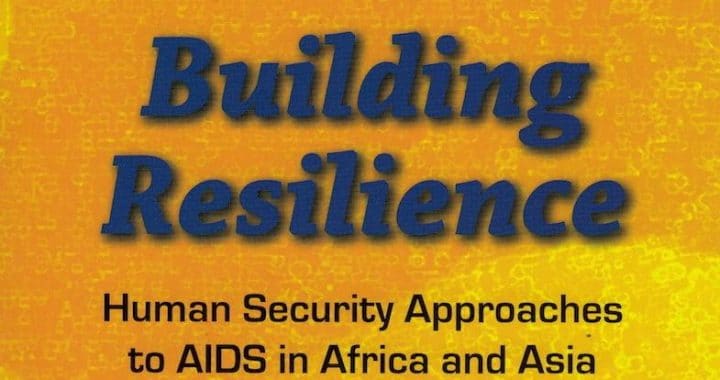
This report analyzes five projects funded by the United Nations Trust Fund for Human Security that deal with AIDS from various angles, such as the intersection between AIDS and issues of poverty, migration, education, and gender inequality.
JCIE Publications | Doing Well by Doing Good: Innovative Corporate Responses to Communicable Diseases

This book presents case studies of innovative approaches by 12 corporations to deal with the spread of AIDS, malaria, and tuberculosis; the authors focus on the motivations behind corporate engagement and the evolution of these programs