
Asia Pacific Security Outlook (APSO)

From 1997 to 2005, JCIE sponsored the Asia Pacific Security Outlook (APSO), an annual research project on regional security issues that produced a publication of the same name. The APSO project monitored changing perceptions of countries in the region in regard to their security environment, national defense issues, and contributions to regional and global security.
Vision of Asia Pacific in the 21st Century
This multinational research project brought together a team of young scholars to examine the significant mid-term and long-term challenges facing the Asia Pacific region. The project began with a general assessment of the broad cultural changes affecting the region, and moved on to an examination of specific issues most important to building a peaceful, prosperous, and just region for the 21st century.
Regulatory Harmonization Task Force

In 2018, JCIE’s Executive Committee on Global Health and Human Security created a Task Force for Promoting Pharmaceutical and Medical Device Regulatory Harmonization in Asia. The group, comprised of 15 experts from industry, academia, and government, seeks to formulate recommendations on how Japan could improve access to pharmaceuticals and medical devices in Asia.
Population Decline & Immigration in Japan
A robust dialogue on immigration is essential to combating and solving the burdens that continued population decline will place on Japanese society. With the goal of playing a guiding role in that dialogue, JCIE is building upon its previous work to implement a new series of initiatives that addresses population decline and a vision for accepting foreigners into Japan.
Democracy for the Future: Sunnylands Intitative
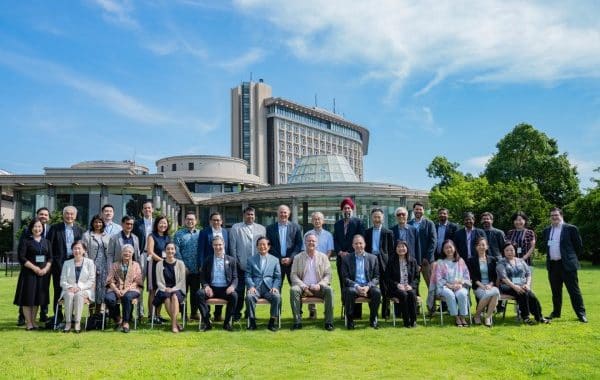
Democracy for the Future: SUNNYLANDS INITIATIVE Since January 2020, JCIE has been involved in an initiative convening key Indo-Pacific thought leaders on democracy from Australia, Japan, India, Indonesia, Malaysia, the Philippines, South Korea, Taiwan, and the United States for a series of discussions on how to advance democratic principles and governance, and human rights in […]
Ten Years of Asia-Europe Meeting (ASEM)
On the occasion of ASEM’s tenth anniversary, the Foreign Ministries of Finland and Japan sponsored a research project, “ASEM’s Role in Enhancing Asia-Europe Cooperation: Ten Years of Achievements and Future Challenges,” to evaluate the ASEM process and explore future possibilities.
An Enhanced Agenda for US-Japan Partnership
JCIE and the Japan Foundation Center for Global Partnership undertook a study to explore how bilateral cooperation can be deepened in order to face common challenges, strengthen regional and global stability and prosperity, and, ultimately, make the US-Japan alliance more robust and versatile in light of wide-ranging developments that had begun to reshape Asia at the start of the 20th century.
A Gender Agenda: Asia-Europe Dialogue
A Gender Agenda was conceived to facilitate a dialogue on broad gender issues between two major regions of the world, Asia and Europe. The project aimed to foster discussion on the issue of gender mainstreaming and to act as one forum for international exchange on gender issues at the civil society level.
An Intellectual Dialogue on Building Asia’s Tomorrow
In a May 1998 speech, the late Keizo Obuchi expressed his concern for the human toll that economic crisis was taking in East Asia, calling for the mobilization of intellectual resources to respond to these consequences. His initiative resulted in the creation of An Intellectual Dialogue on Building Asia’s Tomorrow, launched by JCIE in collaboration with the Institute of Southeast Asian Studies (ISEAS).
ASEAN-Japan Dialogue
In 1977, JCIE initiated the ASEAN-Japan Dialogue to address salient issues in the ASEAN-Japan bilateral relationship. The project was organized in six phases over the period of fifteen years, and the subjects under study included the roles of trade and investment in the development of ASEAN countries, ASEAN-Japan mutual perceptions, and the concept of a Pacific community.