
Exchange with the World Affairs Councils of American (WACA)

From 1986 to 2001, JCIE and WACA jointly carried out the Japan Study Program, consisting of study tours every other year for the leaders of world affairs councils. These tours were aimed at improving the relationship between Japan and the United States, raising the level of interest in and understanding of Japanese society, and creating networks between community leaders.
Japan-United States Economic Relations Group (Wisemen’s Group)
This group of eight leading private citizens was charged with the task of examining the factors affecting long-term bilateral economic relations between the United States and Japan. JCIE was asked to serve as the Japanese secretariat, with JCIE Director Tadashi Yamamoto as an executive director of the group.
JCIE/USA Executive Seminars
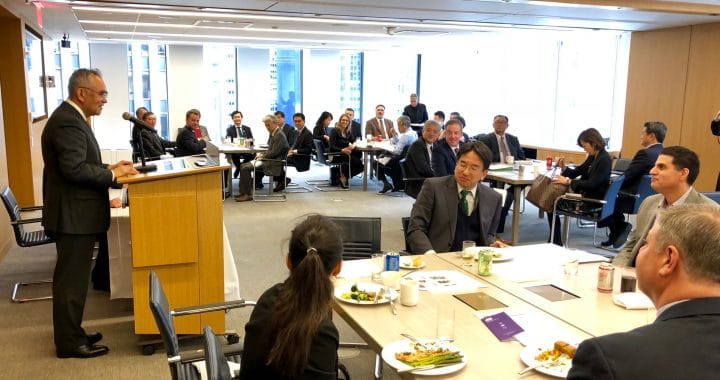
JCIE/USA held a series of executive seminars for the US-Japan business community in New York. Drawing on our extensive network of experts from the political and scholarly communities, these lively discussions provided unique perspectives and an interactive environment for our invited guests. A new series of executive programs has subsequently been launched.
New Perspectives on US-Japan Relations
In 1998, JCIE launched a research project, led by Professor Gerald Curtis of Columbia University, that attempted to address how US and Japanese national interests intersect in terms of the economic, political, and security issues facing post–cold war East Asia, as well as in the context of globalization.
Reinvigorating US-Japan Policy Dialogue and Discussion in a Time of Political Change
During the last decade there has been increasing concern about the state of US-Japan policy dialogue and exchange. To address these concerns, JCIE launched this study in January 2009 to examine the state of policy dialogue between both countries and assess the nongovernmental linkages that have facilitated contact between political leaders and policy experts in each country.
Shimoda Conference Series
The First Shimoda Conference (then also known as the Japanese-American Assembly) took place in 1967 as a forum for high-level but unofficial discussions of critical issues in US-Japan relations, the first of its kind in the postwar US-Japan relationship. The dialogues were held occasionally through 2011.
Strategic Assistance | Asia Pacific Stability and Disaster Relief
A joint research program between the National Bureau of Asian Research (NBR) and JCIE that explored how the United States and Japan can elevate humanitarian assistance and disaster relief (HA/DR) operations to be a key component of their combined regional security strategy.
The Role of Philanthropy in Postwar US-Japan Relations
This project was designed to fill gaps in the knowledge of US-Japan relations and shed light on the historic role of philanthropy and civil society in international relations.
United States-Japan Advisory Commission (1983–1984 Wisemen’s Group)
The United States–Japan Advisory Commission was jointly established in May 1983 by then President Reagan and then Prime Minister Nakasone to review issues in the bilateral relationship from a long-term perspective and to make recommendations on the conduct of the relationship.
US-Japan Dialogue on Asia
In May 1999, a small meeting of 18 top opinion leaders from Japan and the United States was convened in Tarrytown, New York, by former US Secretary of State Henry Kissinger and former Secretary-General of the Liberal Democratic Party Koichi Kato. The goal of the meeting was to discuss future US-Japan cooperation in Asia.