Engaging the United States in an Emerging East Asia Community

In cooperation with the United States Asia Pacific Council, JCIE launched a joint study and dialogue in 2004 that explores Asian actors’ incentives, goals, and visions of regional community; potential US reactions; and ways of guiding community-building efforts so that they meet the interests of all parties by enhancing stability and prosperity in the region.
Japan 101 Online Course: Understanding US-Japan Relations
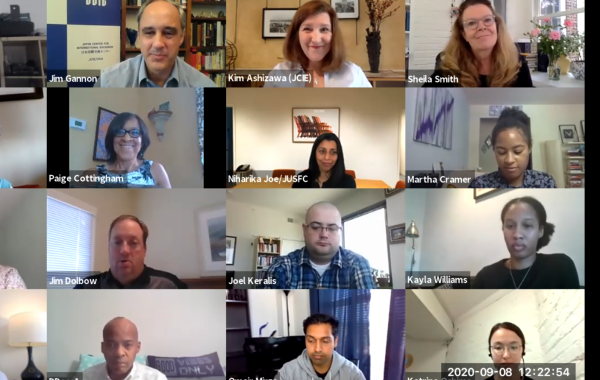
An online course for Congressional staff to bring them up-to-date on the US-Japan relationship and its importance in the US’s approach to Asia.
Global ThinkNet Fellows | The Japan-US Alliance: New Challenges in the 21st Century
A group of six young scholars examined the elements that might affect the Japan-US alliance in coming decades, including domestic public opinion and politics, tensions between other countries, and cultural outlook. Their final papers were published by JCIE as an edited volume, Japan-US Alliance: New Challenges for the 21st Century.
Force, Order, and Global Governance: US, German, and Japan Perspectives
In 1999, JCIE and the Brookings Institution launched a project to help guide the process of consensus-building by examining the key areas of contention in greater depth from the perspectives of the United States, Germany, and Japan.
Governance for a New Century: Japanese Challenges, American Experience
In 1998, JCIE and the Brookings Institution launched a comparative study of the patterns of governance in Japan and the United States based on the premise that they face many similar challenges in this arena. The final papers from this project were published in English in May 2002.
Guidance for Governance: Comparing Alternative Sources of Public Policy Advice
Beginning in 1999, JCIE and the Brookings Institution initiated a comparative assessment of the state of alternative sources of policy advice in eight democratic countries. Drafts of the papers were presented and discussed at a workshop held in Tokyo on May 28, 2000, as well as during one of the sessions at the Global ThinkNet Conference, held in May 2000.
Japan-United States Economic Relations Group (Wisemen’s Group)
This group of eight leading private citizens was charged with the task of examining the factors affecting long-term bilateral economic relations between the United States and Japan. JCIE was asked to serve as the Japanese secretariat, with JCIE Director Tadashi Yamamoto as an executive director of the group.
JCIE/USA Executive Seminars
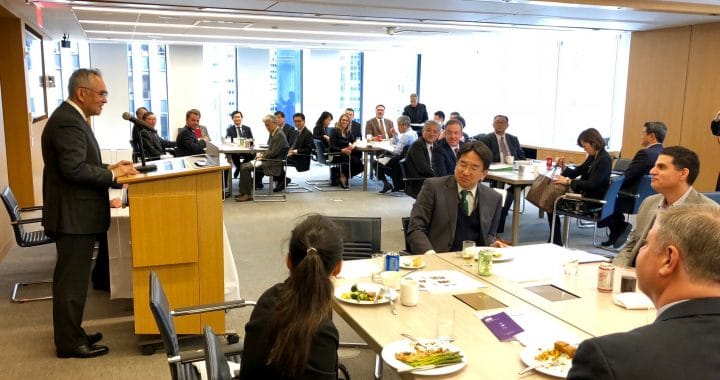
JCIE/USA held a series of executive seminars for the US-Japan business community in New York. Drawing on our extensive network of experts from the political and scholarly communities, these lively discussions provided unique perspectives and an interactive environment for our invited guests. A new series of executive programs has subsequently been launched.
Managing China-Japan-US Relations and Strengthening Trilateral Cooperation
In 2007, JCIE launched a study and dialogue project aimed at developing a deeper understanding of the complex dynamics of the China-Japan-US trilateral relationship, identifying the issues central to managing stable and cooperative relations, and examining ways of promoting more meaningful cooperation on key challenges.
New Perspectives on US-Japan Relations
In 1998, JCIE launched a research project, led by Professor Gerald Curtis of Columbia University, that attempted to address how US and Japanese national interests intersect in terms of the economic, political, and security issues facing post–cold war East Asia, as well as in the context of globalization.