
Corporate-NGO Partnership in Asia Pacific

In August 1997, JCIE began researching the effectiveness of philanthropic collaboration in Asia Pacific with an 18-month grant from the Hitachi Foundation. The research entailed assessing 12 successful instances of philanthropic collaboration, which were aimed at providing a means to understand how these corporate-NGO partnerships work and to cast light on the philosophy behind corporate philanthropy.
Europe-Japan Conference
Compared to relations with the United States, Japan’s ties with Europe have been weak and lopsided. Awareness of the need to promote mutual understanding and regular contact between Europeans and Japanese prompted JCIE to launch in 1975 a series of nongovernmental exchange meetings known as the Europe-Japan Conferences, nicknamed the “Hakone Conferences” after the venue of the first meeting.
Council for Asia-Europe Cooperation (CAEC)
The main purpose of the CAEC was to encourage and facilitate greater cooperation among Asian and European intellectuals and policy specialists in order to enhance discussions about the future direction of Asia-Europe relations. CAEC is managed by a steering committee comprising 12 research institutions in Asia and Europe.
Exchange with the World Affairs Councils of American (WACA)
From 1986 to 2001, JCIE and WACA jointly carried out the Japan Study Program, consisting of study tours every other year for the leaders of world affairs councils. These tours were aimed at improving the relationship between Japan and the United States, raising the level of interest in and understanding of Japanese society, and creating networks between community leaders.
Force, Order, and Global Governance: US, German, and Japan Perspectives
In 1999, JCIE and the Brookings Institution launched a project to help guide the process of consensus-building by examining the key areas of contention in greater depth from the perspectives of the United States, Germany, and Japan.
Force, Intervention, and Sovereignty
Under the direction of JCIE Senior Fellow Koji Watanabe, a team of researchers examined the growing debate in Asia over the appropriate use of force, the conditions under which intervention merits international sanction, and the limits of national sovereignty.
Governance and Civil Society in Japan
In the fall of 1996, JCIE began a multifaceted, long-term study and dialogue project on the theme of “Globalization, Governance, and Civil Society.” The overall objective of the project was to explore the role of civil society in improving domestic as well as international governance and to explore ways of strengthening civil society in Japan and abroad.
Governance for a New Century: Japanese Challenges, American Experience
In 1998, JCIE and the Brookings Institution launched a comparative study of the patterns of governance in Japan and the United States based on the premise that they face many similar challenges in this arena. The final papers from this project were published in English in May 2002.
Guidance for Governance: Comparing Alternative Sources of Public Policy Advice
Beginning in 1999, JCIE and the Brookings Institution initiated a comparative assessment of the state of alternative sources of policy advice in eight democratic countries. Drafts of the papers were presented and discussed at a workshop held in Tokyo on May 28, 2000, as well as during one of the sessions at the Global ThinkNet Conference, held in May 2000.
India-Japan Policy Dialogue
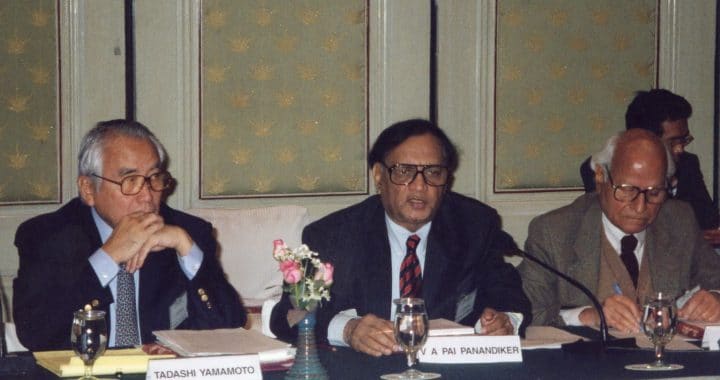
The India-Japan Policy Dialogue was held on February 11–12, 2000, in New Delhi. Over 30 prominent researchers and leaders gathered to examine the future of India-Japan relations. Discussions focused on the domestic political and economic situations in each country; emerging global security scenarios; and ways to bolster India-Japan cooperation in the economic, trade, and cultural fields.