
Force, Order, and Global Governance: US, German, and Japan Perspectives

In 1999, JCIE and the Brookings Institution launched a project to help guide the process of consensus-building by examining the key areas of contention in greater depth from the perspectives of the United States, Germany, and Japan.
Force, Intervention, and Sovereignty
Under the direction of JCIE Senior Fellow Koji Watanabe, a team of researchers examined the growing debate in Asia over the appropriate use of force, the conditions under which intervention merits international sanction, and the limits of national sovereignty.
Northeast Asia Cooperation Dialogue
The Northeast Asia Cooperation Dialogue (NEACD) was launched in 1993 and JCIE served as Japan secretariat in 2005 and 2006. The 17th meeting drew intense media attention and examined national perspectives on regional security, issues related to nuclear verification, and prospects for Track 1 and Track 2 diplomacy.
Shimoda Conference Series
The First Shimoda Conference (then also known as the Japanese-American Assembly) took place in 1967 as a forum for high-level but unofficial discussions of critical issues in US-Japan relations, the first of its kind in the postwar US-Japan relationship. The dialogues were held occasionally through 2011.
Strengthening Nongovernmental Contributions to Regional Security Cooperation
JCIE conducted a study from 2009–2015 to explore how such nongovernmental initiatives can concretely contribute to regional security cooperation in East Asia.
Strategic Assistance | Asia Pacific Stability and Disaster Relief
A joint research program between the National Bureau of Asian Research (NBR) and JCIE that explored how the United States and Japan can elevate humanitarian assistance and disaster relief (HA/DR) operations to be a key component of their combined regional security strategy.
Korea-Japan Forum | 31st Meeting
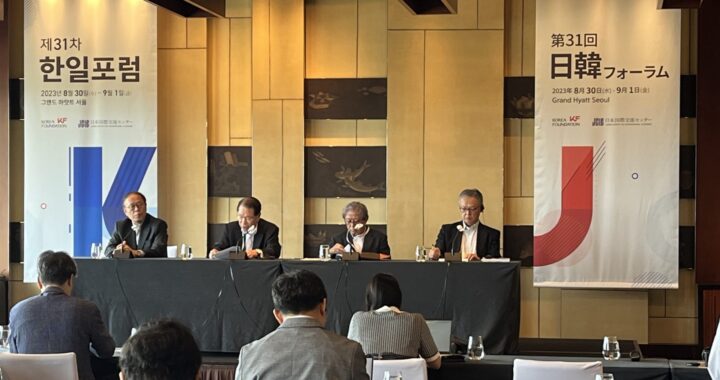
The 31st Korea-Japan Forum, held in Seoul, brought together participants to discuss domestic political shifts and bilateral relations, economic and security issues facing the two countries, and the latest geopolitical developments in East Asia. The event also featured a Junior Forum for youths from the two countries. The 8th Japan-Korea Forum Award was also held to celebrate those to made significant contributions to Japan-Korea friendship and development.
Second Sunnylands Initiative Retreat Hosted in Japan
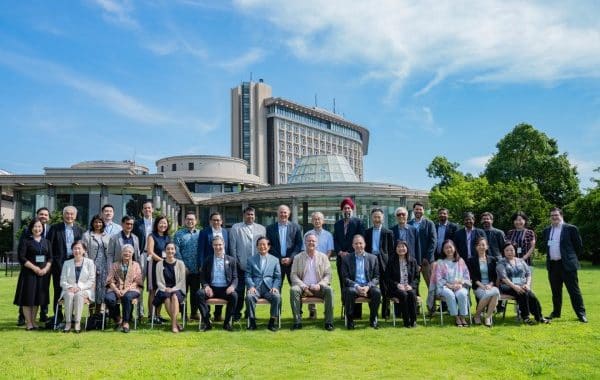
Responding to the urgent need to address the threats to democracy in the Indo-Pacific region and around the world, JCIE convened the second meeting of the Sunnylands Initiative on Enhancing Democratic Partnership in the Indo-Pacific (Sunnylands Initiative) on August 1-3, 2022 in Tokyo and Odawara, Japan
Interviews from the Sunnylands Initiative Retreat
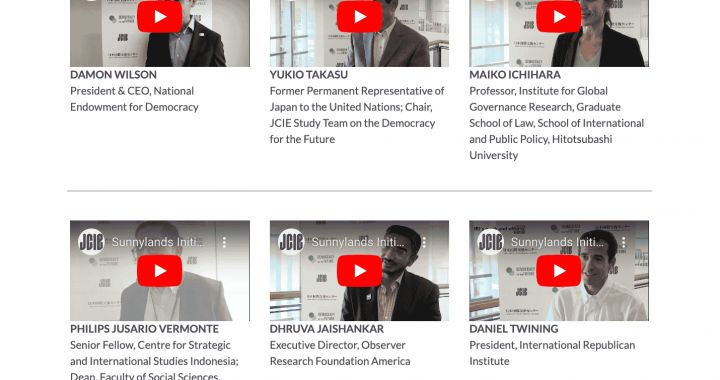
At the second meeting of the Sunnylands Initiative on Enhancing Democratic Partnership in the Indo-Pacific region in Japan, select participants shared their thoughts on key issues concerning democracy in the region in a series of short video clips.
UK-Japan 21st Century Group | 38th Conference
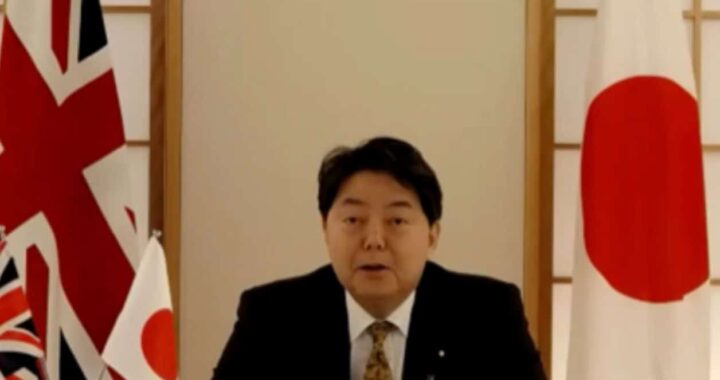
The 38th annual meeting of the UK-Japan 21st Century Group was held online due to the ongoing COVID-19 pandemic with the participation of around 20 members from each country, who held discussions on the latest political and economic developments in Japan and the United Kingdom.