
Australia Parliamentary Fellowship

This program selects Japanese post-graduate students who have shown a strong interest in Australia-Japan relations for internships in the office of a member of Australia’s Parliament, where they conduct research under the guidance of an ANU professor. Fellows from Australia are also selected to intern in the Japanese Diet and carry out research with the support of a professor.
Australia-Japan Young Political Leaders Exchange
The Australia-Japan Young Political Leaders Exchange Program was launched in 1991 under the auspices of JCIE and the Australian Political Exchange Council (APEC) to foster greater understanding, dialogue, and network formation between the next generation of leaders in both countries and to promote a sound, cooperative relationship between Japan and Australia.
Europe-Japan Conference
Compared to relations with the United States, Japan’s ties with Europe have been weak and lopsided. Awareness of the need to promote mutual understanding and regular contact between Europeans and Japanese prompted JCIE to launch in 1975 a series of nongovernmental exchange meetings known as the Europe-Japan Conferences, nicknamed the “Hakone Conferences” after the venue of the first meeting.
Force, Order, and Global Governance: US, German, and Japan Perspectives
In 1999, JCIE and the Brookings Institution launched a project to help guide the process of consensus-building by examining the key areas of contention in greater depth from the perspectives of the United States, Germany, and Japan.
Force, Intervention, and Sovereignty
Under the direction of JCIE Senior Fellow Koji Watanabe, a team of researchers examined the growing debate in Asia over the appropriate use of force, the conditions under which intervention merits international sanction, and the limits of national sovereignty.
Governance for a New Century: Japanese Challenges, American Experience
In 1998, JCIE and the Brookings Institution launched a comparative study of the patterns of governance in Japan and the United States based on the premise that they face many similar challenges in this arena. The final papers from this project were published in English in May 2002.
India-Japan Policy Dialogue
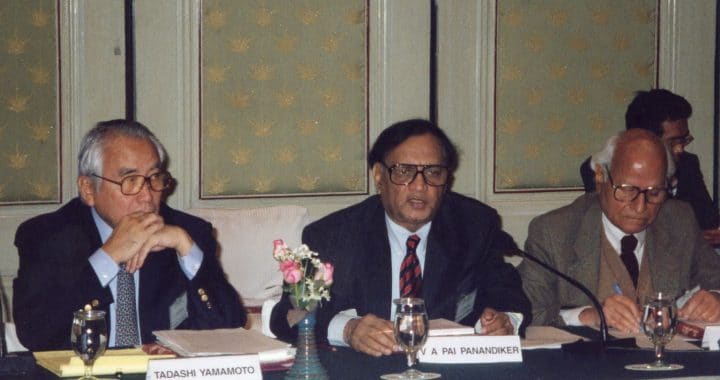
The India-Japan Policy Dialogue was held on February 11–12, 2000, in New Delhi. Over 30 prominent researchers and leaders gathered to examine the future of India-Japan relations. Discussions focused on the domestic political and economic situations in each country; emerging global security scenarios; and ways to bolster India-Japan cooperation in the economic, trade, and cultural fields.
Israel-Japan Intellectual Exchange Program
From 1993 to 2004, JCIE carried out a bilateral intellectual exchange program with Israel to examine pressing concerns of mutual concern to the two countries.
Japan-United States Economic Relations Group (Wisemen’s Group)
This group of eight leading private citizens was charged with the task of examining the factors affecting long-term bilateral economic relations between the United States and Japan. JCIE was asked to serve as the Japanese secretariat, with JCIE Director Tadashi Yamamoto as an executive director of the group.
Korea-Japan Joint Committee for Promoting History Studies
JCIE served as the Japanese secretariat for the Korea-Japan Joint Committee for Promoting History Studies, an initiative agreed upon at a 1997 summit between Japanese Prime Minister Ryutaro Hashimoto and Korean President Kim Young-Sam. The Committee was launched in July 1997 with the goal of finding effective ways to enhance studies of history in the two countries.